Published in Nothing remained unchanged but the clouds. This text explores the development of the La Vojo Returne engagement with Grandpré and its residents.
This project began unexpectedly as a lockdown diversion during the early months of the Covid-19 pandemic. With other plans on hold, I turned my attention to a small set of photographic negatives I had purchased on eBay the previous year. They came with only a sparse label: “Taken by German medical officer, WWI.” The images struck me as odd, almost Dadaist in tone – fragments of a disjointed reality, frozen by the lens of a pocket camera. One negative in particular, showing a vista of distinct architectural forms. I felt sure it could be geographically identified.
Google reverse image search yielded nothing, so I turned to a more laborious method. Armed with a combination of maps, Google Street View, and online antique postcard databases, I began systematically cross-checking towns and villages that lay along or just behind the Western Front. Lockdown gave me the time for this kind of obsessive research. Eventually, I succeeded in identifying the location as Grandpré, a village in the German-occupied Ardennes region of northern France.
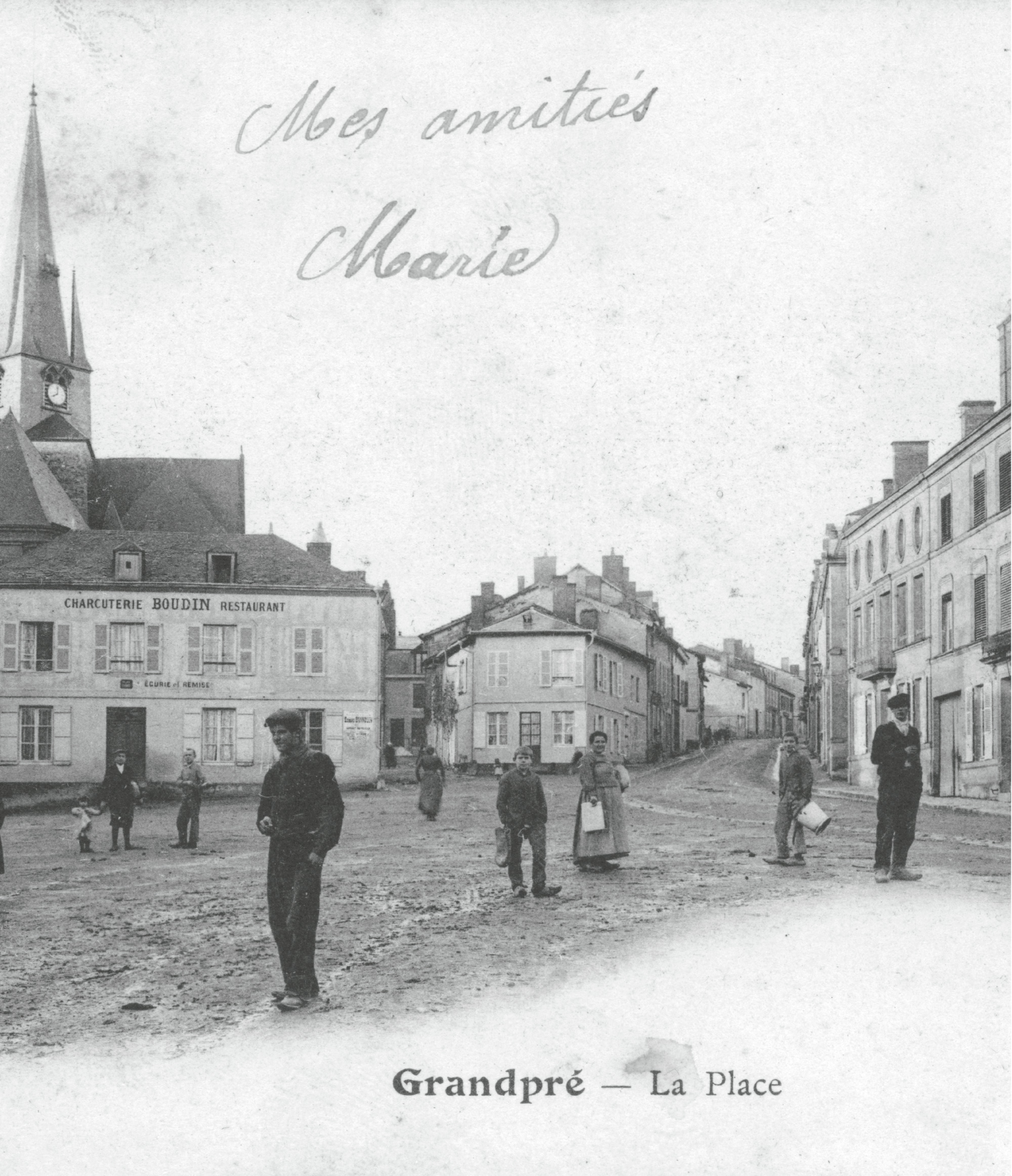
Through the reseller postcard sites I discovered a wide range of German postcards of Grandpré’s environs were available. They had mapped and created an extraordinarily detailed Grandpré. Sat in isolation at my computer, these postcards appeared to represent the most complete picture of the place – far more so than French postcard collections, pre- or post-war, and even the contemporary Google Street View portal. I found this liminal moment a fascinating representation and began to collect these German depictions of a French place.
The postcard collection that gradually unfolded in front of me revealed a broad typology of production methods and visual intentions. Some were mass-produced using rotogravure or halftone lithographic printing techniques – typically in monochrome – by numerous commercial publishers and printers often working in concert with the military. Others were photographic postcards, contact-printed on postcard stock using ‘quarter-plate’ or 122 format plate cameras, by semi-independent or itinerant photographers operating in the occupied zones. These individuals, sometimes travelling with portable darkrooms, created limited numbers of direct photographic impressions – images that sit closer to documentary immediacy than the stylised prints of mass circulation.¹
Both types coexisted in the wartime postal ecology: one aligned with propaganda and official documentation, the other more intimate, functional, and opportunistic. The tension between these forms – between the reproducible and the singular, the official and the personal – became an area of quiet fascination for me. The photographic postcards, in particular, often bore physical traces of their making: uneven borders, exposure flaws, hand-stamped titles, and, occasionally, faint pencil inscriptions or amendments to the glass plates.
As these cards arrived in the post, I scanned each one at high resolution to create a growing digital archive. I began cataloguing them chronologically, noting their production typology, postcard printer or publisher, date written and date franked, the sender’s identity (when legible), recipient, and destination. Over time, this archive developed into a structured dataset – less a passive collection than an active mapping of memory, print culture, and postal intimacy during occupation. It became clear that these cards were not merely souvenirs of war, but agents in a dispersed, highly mediated visual communication system – one that captured not just places, but ways of seeing under the conditions of war.²
As I continued collecting and archiving the postcards, I became increasingly drawn to the handwritten messages on the reverse. Many were written in old Sütterlin script, often in shorthand, and frequently faded or fragmentary. To fully understand them, I had to reach out to researchers and academics with specialist knowledge of historic German scripts and epistolary translation. These academic collaborations with the University of Leeds and a translator from Braunschwieg in Germany were instrumental in revealing the human voice behind the images – a voice often constrained by censorship, yet all the more poignant for what it hinted at rather than said.
I became particularly interested in the kinds of things people wrote about when they couldn’t say what they really meant. Small gestures, everyday observations, trivialities. These were not grand statements or heroic declarations, but what Georges Perec would describe as the infra-ordinary – the unnoticed residue of life.³ Perec’s fascination with the habitual and the overlooked became a key lens through which I viewed the postcards. These messages, constrained by war but grounded in the personal, were vessels for familial histories that were local, intimate, and yet also transnational – histories that crossed borders regardless of allegiance. Perec reminds us that these small histories are often the most beautiful, and it was this quiet beauty that I wanted to honour in my own photographic response later in the project.
During this period of research, I also read Erich Maria Remarque’s Der Weg Zurück (The Way Back), a novel that deeply resonated with the emotional landscape suggested by the postcards. Its depiction of post-war displacement and psychological malaise seemed to echo not only the historical moment captured in the cards, but also our contemporary, lockdown-altered world. On impulse, I bought a first edition Esperanto translation of the novel – a symbolic gesture toward shared language, shared loss, and the fractured hope of transnational communication.⁴
As the archive of postcards grew, I found myself increasingly preoccupied with the village of Grandpré itself. While it had clearly been under German occupation from the start of the war, it appeared, on the surface, to have escaped the destruction that befell other towns and villages along the Western Front – at least until its liberation by the American army in 1918. I wanted to understand what life had actually been like under occupation: how the war had shaped the rhythms, spaces, and silences of everyday life in the village.
In the course of my research, I joined an American-based Facebook group dedicated to documenting U.S. involvement in World War I. There, I discussed my interest in the postcards. A number of people who ‘liked’ the post appeared to be current residents of Grandpré, and I decided to reach out directly. What began as a tentative online exchange quickly became a more sustained conversation. The residents were generous, curious, and interested in how their village had been seen and represented through these German postcards.
Following this exchange, I wrote a formal proposal to the mayor of Grandpré requesting permission to visit and undertake further research once lockdown restrictions were lifted. The response was enthusiastic. With support from the municipal authorities, I was offered accommodation and the assistance of a local working group to facilitate my research in Grandpré.
To support this developing collaboration, we collectively established a closed Facebook group as a digital meeting point – fittingly titled La Vojo Returne, echoing the Esperanto title of Remarque’s Der Weg Zurück. The group became a safe place to share postcard images, historical references, contemporary photos, and memories. It marked the start of a new phase of the project: one rooted in dialogue, collaboration, and place-based research.⁵
Before setting foot in Grandpré, I had already begun responding visually to the postcards through collage-based interventions. Working in isolation during lockdown, I scanned the original cards and manipulated them using white acrylic paint – a method of gentle disruption. I removed buildings that no longer existed, obscured German military signage on shopfronts and street names, and blanked out architectural features that had been heavily coded by occupation. In some cases, I traced the outlines of buildings subsequently destroyed, the silhouettes of soldiers, rendering them as spectral white outlines – ghosts lingering in the margins of the image. These early works were meditations on absence, displacement, and the layered politics of visual memory. They aimed to question what the postcard shows, and what it cannot show.⁶
When I eventually arrived in Grandpré for the first residency, my approach shifted toward a more embodied, tactile relationship with the landscape. Rather than attempting exact rephotography, I found myself drawn to the minutiae of the place – small details in the environment that held the texture of lived experience: the curve of a hedge-line, the weathering of a wall, the shape of a hollow in the road. These subtle elements often echoed forms or atmospheres present in the original postcards, though rarely in direct correlation. My photography became an act of slow looking, seeking to register what might be left behind in a landscape long after its historical markers have faded.
Taken together, the collage and photographic works form a dialogue – between past and present, presence and loss, the fixed frame of the postcard and the fluid impressions of being there. They function less as documentary evidence and more as visual essays, attentive to the fragile convergence of memory, place, and personal encounter.
Once in Grandpré, the postcards quickly became more than historical artefacts – they became a shared point of reference, a portal through which residents could engage with the village’s past and with one another. At our first collective meeting, I was surprised to discover just how many people had their own extensive postcard collections. Many had inherited them from family members or found them in local flea markets. These images – so carefully made by unnamed German occupiers over a century ago – had, it seemed, become unofficial anchors of memory, representing the village before it was irrevocably changed by war and time.
The conversations that followed revealed a quiet complexity in how the occupation is remembered. While no one forgot the hardships – those who stayed behind, or returned to manage family farms, lived under strict and often dehumanising rule – there was also a nuanced acceptance that the occupying soldiers were often just “doing their nation’s bidding.” The images they produced, while undeniably instruments of control and propaganda, now appeared to many as documents of a place lost, rather than symbols of conquest.
One resident remarked: “This is the first time we’ve collectively discussed Grandpré like this.” That sentence stayed with me. It encapsulated the emotional and cultural significance of the work. What began as a visual investigation had turned into a kind of community self-reflection, mediated through the unlikely material of German field postcards.
The La Vojo Facebook group we created, played a vital role in this process. What started with a few dozen members has grown into a forum of over 500 participants – a number nearly equal to the village’s current population. Residents, émigrés, relatives, and local citizen-historians used the space to share stories, photographs, letters, and fragments of personal and familial memory. The group became an extraordinary repository, though impossible to define as a traditional archive. It is chaotic, unstructured, and deeply human – shaped more by emotion and conversation than taxonomy. And yet, for that very reason, it has offered something truly special: a bottom-up history of a place, told not by institutions, but by those who lived in its wake.⁷
The postcards became vessels for shared reflection, not just on the past, but on how history lives in the everyday – held in buildings, fields, fragments, and in the ways we speak about the places we call home.
Working in Grandpré has shown me just how layered, delicate, and sometimes unpredictable community engagement can be – especially when initiated by an outsider. Language was an immediate and ongoing challenge: not just the task of translating old Sütterlin script or understanding idiomatic turns in conversation, but also the subtler emotional language of trust, relevance, and belonging. I was acutely aware that not everyone would see the point of someone from Manchester arriving with old German postcards and asking questions about their village. Why now? Why this?
In many ways, this unease was part of the story. Grandpré, like many small rural villages, exists in a kind of contemporary marginality – distant from the dominant cultural and political centres, often overlooked or reduced to statistics. For some, the idea that an artist would choose to focus so intently on their home seemed strange, even unnecessary. But over time, through persistence, openness, and genuine curiosity, I witnessed a shift. As one resident noted, it sometimes takes a person from outside to ignite a process of reflection – to hold up a mirror that isn’t clouded by familiarity.
Both Dr. Corinne Painter (University of Leeds) and Lara-Marie Hägerling (Technische Universität Braunschweig) witnessed and took part in this by visiting me on my third residency, where we created and scripted an artist-led walk with residents who participated in an alternative look at their home. Postcards sent from the village were read in German, French and English for the first time since their creation; stories were told and elaborated on by the audience, as we meandered around the streets.
The collaborative nature of the project allowed for a kind of shared authorship. The book that has emerged from this work is not mine alone – it is a testament to collective engagement, built from fragments, memories, conversations, interpretations and participation. The community shaped the project as much as I did. It became a space in which people could reflect on their own place in history, not as distant observers of the First World War, but as inheritors of its local residue.
For me, it has also been a deeply personal and obsessively driven experience. Entirely self-initiated, it evolved without institutional oversight or predetermined outcomes. That freedom allowed the work to unfold organically, guided by instinct and encounter rather than deadlines or deliverables. It has reinforced my belief in the power of images – not just to show us what was, but to invite us into conversations about how we remember, what we value, and how we might begin to see the overlooked.
The title of the book, Nothing Remained Unchanged but the Clouds, emerged halfway through the project, during a chance meeting with Paola Filippucci, an academic from Cambridge who had been researching postcards in a neighbouring department. She shared with me a paper she had written, which drew on Walter Benjamin’s essay The Storyteller. In it, Benjamin laments the loss of storytelling in the wake of the First World War– the way mechanised brutality had rendered experience incommunicable, stripped of continuity, nuance, or form.⁸ What remained, he suggested, was only the elemental, the mute witness: “nothing remained unchanged but the clouds.” The phrase struck a deep chord. It seemed to encapsulate not just the emotional residue of the postcards, but also the fragile threads of memory and meaning we had tried to recover through the project. The clouds – unchanged, indifferent, drifting – became a kind of emblem for the work: a quiet, persistent presence above a landscape where stories had been lost, buried, or only half remembered. The book, like the clouds, does not offer closure. But it offers an invitation: to look again, to listen closely, and perhaps to begin telling stories anew.
¹ Dirk H.R. Spennemann, “Production of German Picture Postcards at the Western Front 1915–1916,” German Studies Review 36, no. 2 (2013): 263–284.
² Lisa Gitelman, Paper Knowledge: Toward a Media History of Documents (Duke University Press, 2014), https://doi.org/10.1215/9780822376811 (accessed April 2025).
³ Georges Perec, “Approaches to What?” in Species of Spaces and Other Pieces (Penguin, 1997).
⁴ Esther Schor, Bridge of Words: Esperanto and the Dream of a Universal Language (Metropolitan Books, 2016), especially Chapter 8, which discusses literary translations in Esperanto as expressions of interwar internationalism and cultural mourning.
⁵ José van Dijck, Mediated Memory in the Digital Age (Stanford University Press, 2007).
⁶ Johanna Drucker, Sweet Dreams: Contemporary Art and Complicity (University of Chicago Press, 2005).
⁷ Sarah Pink, Doing Visual Ethnography (SAGE Publications, 2021).
⁸ Paola Filippucci, ‘In a Ruined Country: Place and the Memory of War Destruction in Argonne (France)’, in Remembering Violence: Anthropological Perspectives on Intergenerational Transmission, ed. by Nicolas Argenti and Katharina Schramm (New York and Oxford: Berghahn Books, 2009), pp. 165–190.